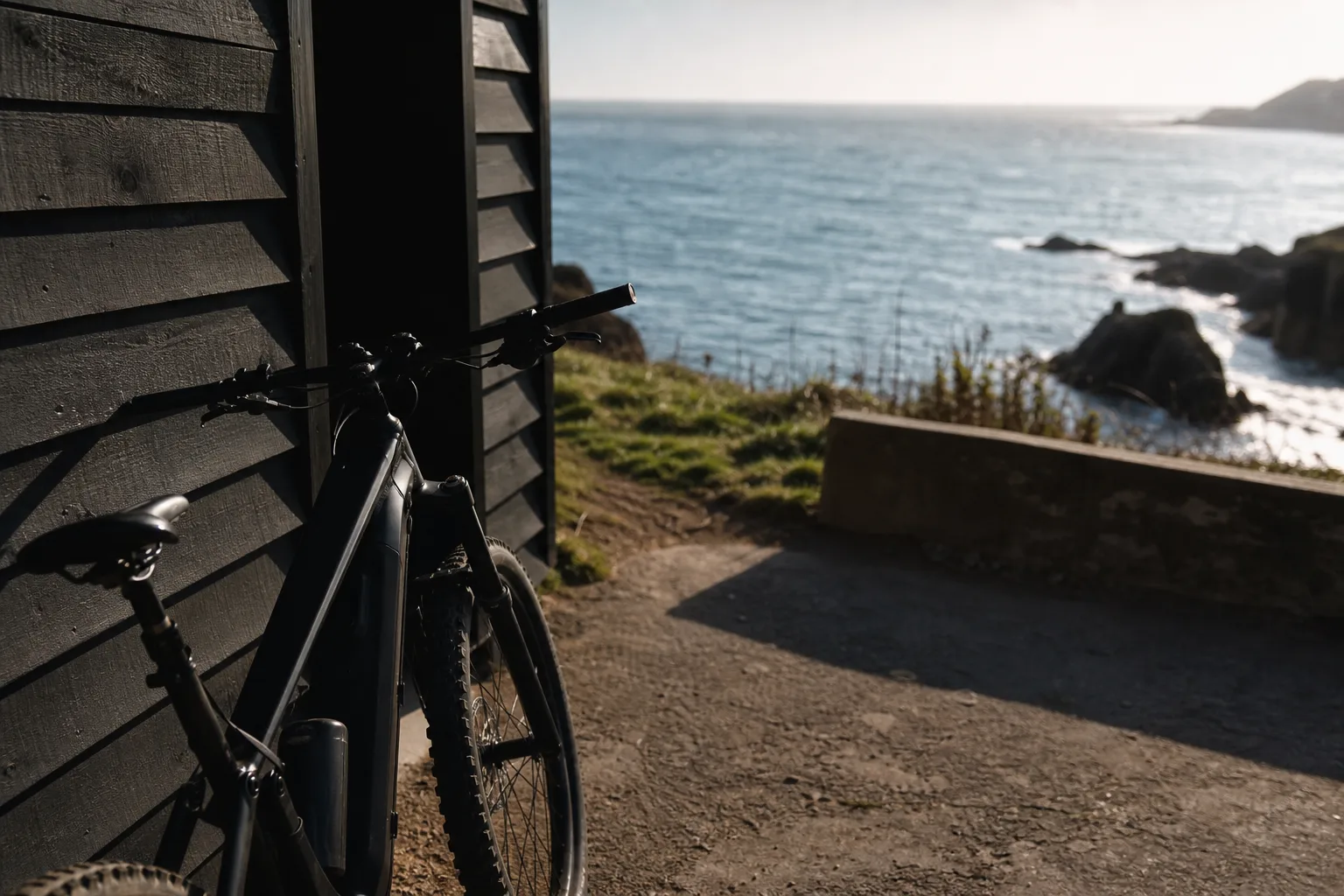
The ordinary errands an assisted bike replaces, the grades and distances involved, and the four decisions that decide whether the swap holds.
The trips that end up on an assisted bike are shorter and duller than the ones people imagine when they picture an electric bicycle. A gallon of milk and a package drop. School at eight and pickup at three. The dentist two neighborhoods over, the hardware store for a single fitting, the ferry terminal at the bottom of the hill where the parking lot fills by seven. In a harbor town these are trips of one to four miles, taken four or five times on a working day, and almost every one of them ends with a climb back up to the house.
The shape of the week, measured rather than guessed
Before any purchase makes sense, it helps to write down a real week: each trip, its distance, and the steepest sustained block on the way home. Most people find the distances are trivially short and the grades are not. A quarter mile at eight percent will stop an unassisted commuter rider in ordinary clothes, and a quarter mile at twelve percent will stop almost anyone who is carrying groceries. Compare that with the car version of the same errand, which costs fifteen minutes of driving and five of parking, and the gap that assistance closes becomes specific rather than aspirational.
The measurement worth taking is the worst one, not the average. A route that averages four percent over a mile can hide a two-block wall at fourteen, and that wall determines which motor, which gearing and which battery capacity you actually need. Phone apps read grade poorly on short segments; a paper map with contour lines, or simply walking the block and noticing where you shorten your stride, gives a better answer. The number goes in a notebook. Everything else on this site is downstream of it.
What the swap costs, honestly counted
The purchase is the visible number, and it ranges widely enough that quoting a figure would mislead. Underneath it sit the costs that decide whether the bike gets ridden: a lock heavy enough to matter, lights that run on their own charge rather than the main battery, fenders and a rack, a rain shell, and somewhere dry to park it that is not a shed forty feet from the door. Then the running costs, which are small but not zero. Electricity for a battery of this size is pennies a charge. Brake pads and chains wear faster than on a bike without a motor, and in salt air, faster still.
Against that, count what stops. A short-trip car mile is the expensive kind: cold starts, stop-and-go, brake wear, parking. Insurance does not fall because you drive less, but fuel and maintenance do, and in a household that has been thinking about a second car, the comparison is no longer a bike against a car but a bike against several thousand dollars a year of ownership. The Consumer Financial Protection Bureau oversees the consumer lending that most car purchases run through, and the monthly payment on a second vehicle is the line item an assisted bike most often removes.
The four decisions everything else hangs on
First, the motor: a mid-drive that uses the gears against a hub motor that does not, which matters mostly above about eight percent grade. Second, the frame and fit, which in practice means standover height, reach, and whether you can put a foot down on a cambered street while holding a load. Step-through geometry is not a concession; it is the correct answer for anyone mounting a loaded bike on a slope, which is why so much of the market sold as a womens electric bike is simply a low-standover frame with shorter cranks and a narrower bar, specifications that suit plenty of riders regardless of how the category is labeled.
Third, the battery and the charging arrangement: capacity sized to the worst week rather than the best day, and a place to charge it that is indoors, above freezing, and not in the same salt-laden air as the drivetrain. Fourth, maintenance, which on a coastal hill means rinsing, drying and lubricating on a schedule, watching brake pad thickness rather than waiting for noise, and accepting that a chain will last a season rather than three. Those four decisions, in that order, settle most of the rest.
What changes in the first month
The reliable change is that trips stop being planned. Errands consolidate less, because there is no parking penalty for going twice, and the two-mile trip you would have skipped in the car gets made. Riders report their route choices shifting toward quieter streets, since the assistance removes the reason to prefer the flat arterial. Time-wise, the honest comparison is close: an assisted bike is often faster door to door under three miles in a town with contested parking, and slower beyond that. The gain is not speed. It is that the trip stops requiring a decision.
Write down the week first, then the steepest block, then the number the household spends on short-trip driving. Those three figures make every question that follows answerable.